

QUICK NAVIGATION
Understanding Ratios
Gear ratios determine how power from the engine is delivered to the wheels. By changing the size of the front and rear sprockets, you can control acceleration, top speed, and how the engine performs on different tracks.
THE DRIVETRAIN
Power flows from the engine, to the front sprocket, through the chain, to the rear sprocket, and finally to the wheels.

IN SIMPLE TERMS
Larger Rear Sprocket
More acceleration
Higher RPM
Smaller Rear Sprocket
More top speed
Lower RPM
Larger Front Sprocket
More top speed
Lower RPM
Smaller Front Sprocket
More acceleration
Higher RPM
KEY TAKEAWAY
There is no "perfect" gear ratio. The right combination depends on your track, conditions, engine package, and driving style.


How Gearing Affects The Car
Small gearing changes can dramatically affect acceleration, RPM, drivability, and overall feel on track. Even a one tooth change can make a big difference. Gearing changes do not create horsepower. They change how power is applied to the track.
MORE GEAR
(Changing rear to larger gear or front to smaller gear)
MORE ACCELERATION
Stronger pull when getting on the gas.
HIGHER RPM
Engine runs at a higher RPM at a given speed.
HARDER CORNER EXIT PULL
More drive off corner.
REACHES RPM QUICKER
Gets into the powerband faster.
BETTER UNDER HEAVY LOAD
Helps pull engine through heavy/tacky conditions
THINGS TO WATCH
• Can hit the limiter sooner
• Less speed potential on long straights
• To much gear can make the car feel overly responsive
LESS GEAR
(Changing rear to smaller gear or front to larger gear)
MORE SPEED POTENTAL
Allows the car to reach a high top speed.
LOWER RPM
Engine runs at a lower RPM at a given speed.
MORE WHEEL SPEED
The wheel turn more for the same RPM.
SMOOTHER ACCELERATION
Power comes on more gradual and linear.
BETTER ON LARGER TRACKS
Helps on big or high speed tracks.
THINGS TO WATCH
• Can lug off corners
• Slower acceleration
• Can struggle on a more heavy/tacky track
HIGHER RATIO

FRONT SPROCKET
REAR SPROCKET
CHAIN
13 / 48 = 14.65
Favors acceleration and corner exit pull.
VS
14 / 48 = 13.89
LOWER RATIO
Favors speed potential and top end.
Larger front sprocket and smaller rear sprocket can have the same effects as a smaller front sprocket and larger rear sprocket
TOO MUCH GEAR FEELS LIKE
RPM climbs very quickly speed stops increasing
Hits the limiter early on the straight
Engine feels aggressive entering the straight
NOT ENOUGH GEAR FEELS LIKE
Engine struggles to recover RPM
Car feels lazy leaving the corner
Acceleration feels slower overall
QUICK TIP
Gearing does not create horsepower. It changes how power reaches the track.
Understanding RPM Range
Proper gearing isn't about finding the highest RPM possible. It's about keeping the engine operating in its most effective range around the entire track.
RPM RANGE (EXAMPLE)

SWEET SPOT ZONE
Suzuki GSX-R600 (15,800 - 16,800)
(Example range will vary by engine and setup)
• RPM should be in the engines RPM sweet spot as you approach corner entry.
• As deceleration, braking and turn-in begin, RPM will start to fall as engine load increases and engine speed decreases.
• This is usually where the engine reaches the lowest RPM point of the lap cycle.
• Gear ratio largely determines how far RPM drops when entering the corner.
• Excessive RPM drop can indicate gearing is to tall for current conditions.
This is often where gearing problems first become noticeable
CORNER ENTRY
• Engine RPM should begin stabilizing as throttle is slowly reintroduced.
• Take note of how quickly the engine responds and starts recovering RPM.
• Slow recovery can indicate wrong gearing which is struggling to keep the engine in it effective range.
• Track surface and grip level often influence RPM recovery characteristics.
Watch for RPM stability and recovery rate
MID CORNER
CORNER EXIT
• Maximum engine load and acceleration occur as the driver increases the throttle.
• Engine RPM should quickly return toward it effective operating range.
• Gearing affects how aggressively the engine can recover while maintaining forward drive.
• The goal is smooth recovery without excessive RPM drop while in the corner and to not hit the rev limiter to soon on entry.
The goal is strong recovery back into the powerband
COMMON SYMPTOMS
SYMPTOM
POSSIBLE CAUSE
Hits limiter too early
Gear ratio too high
Engine feels lazy on exit
Gear ratio too low
RPM drops excessively on entry
Gear ratio too low
Pulls hard but slow on straight
Gear ratio too high

RPM Strategy is about spending time in the right RPM range not the highest.
Common Gearing Mistakes
Small gearing changes can completely change how a micro sprint feels. Many common problems come from chasing symptoms instead of understanding what the engine is telling you.
CHASING TOP SPEED
"The fastest car down the straight is not always the fastest car overall"
Many teams gear for maximum speed only to sacrifice acceleration and RPM recovery.
IGNORING TRACK CHANGES
Track conditions evolve throughout the night. Heavy, tacky conditions and late-night slick conditions may require different gearing approaches.
FOLLOWING OTHERS
Gearing that works for another team may not work for you:
• Different engine package • Driving style • Chassis • Track conditions
MAKING LARGE GEAR CHANGES
Changing several teeth at once can make it difficult to understand what actually improved. Small changes often provide clearer feedback.
IGNORING DATA
Watch RPM trends for:
• Entry RPM • Recovery RPM • Straightaway RPM • Limiter behavior
The engine tells you what it wants.
Download Resources
Suzuki - Micro Sprint
Yamaha - Micro Sprint
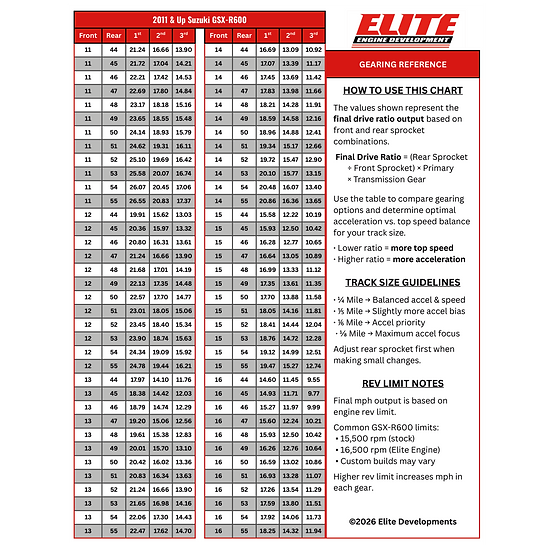
GEAR CHART
Use the download links below to access engine-specific micro sprint gear charts with pre-calculated front and rear sprocket combinations and overall ratios for gears 1–3.